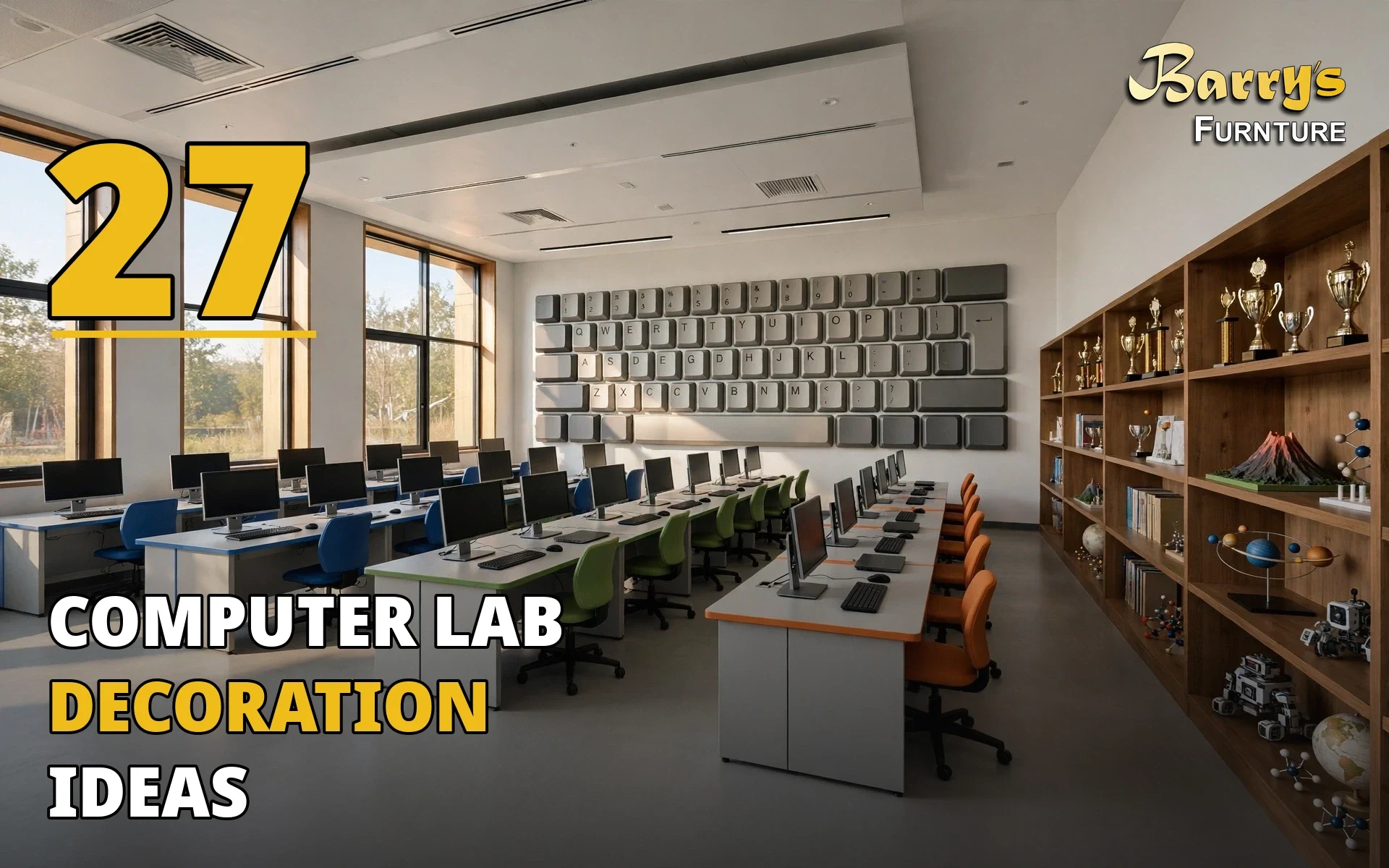
The best computer lab decoration ideas make the room teach: a giant keyboard wall, shortcut charts, colour-coded station zones and built-in display shelving. Start with the walls students face, then the boards they use daily. Our computer lab furniture is built around these displays, so decor and desks arrive as one planned room.
Computer lab decoration ideas work on two levels at once. The room has to look inviting when a class walks in, and every wall has to earn its place while the lesson runs.
That is why this guide comes from an institutional furniture workshop, not a print shop. You get 27 ideas we can build, frame, panel and install — with honest effort levels and PKR cost bands for each one.
Why Lab Decoration Is a Build Job, Not a Print Job
Paper charts and taped posters are the usual starting point, and they fail in predictable ways. Edges curl, tape marks the paint, and a display that looked fresh in September looks tired by winter.
Built decoration lasts because it is furniture: framed boards, panelled walls, shelving and plaques fixed once and cleaned like any other fitting. It is the same thinking behind our IT computer lab installations, where the displays are part of the room build.
Plan the room zone by zone and every idea below has a home. No zone needs all 27 ideas — two or three per zone is a finished lab.
Wall Decoration Ideas That Teach
1. Giant Keyboard Wall Display

A full keyboard drawn at wall scale turns the main teaching wall into a reference students use in every lesson. Each key is a separate panel, so home-row keys can carry a different colour from the number row.
We build it as individual laminated boards on a painted backing panel, sized to the wall you have. It survives years of pointing, tapping and cleaning, unlike a paper print that curls within a term.
- Best For: Primary and middle school labs
- Build: Painted panel with laminated key boards
- Effort: Medium
- Cost Band: Rs 18,000 – 35,000
2. Keyboard Shortcut Chart Wall

Shortcut charts earn their wall space because students read them while they work. A framed grid of the twenty shortcuts your syllabus actually uses beats a generic poster nobody checks.
Group the shortcuts by task — editing, formatting, file handling — and frame each group as its own board. When software changes, you swap one board instead of reprinting the whole wall.
- Best For: School and college labs
- Build: Framed printed boards in a grid
- Effort: Easy
- Cost Band: Rs 8,000 – 16,000
3. Binary Code Accent Wall
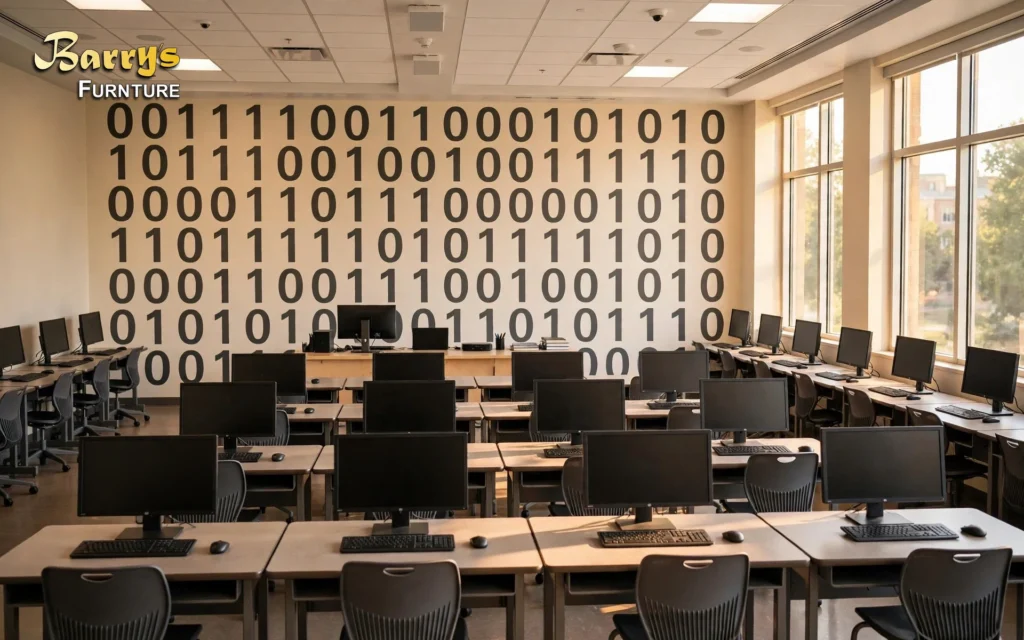
A binary accent wall gives a lab its identity in a single paint-and-panel treatment. Rows of ones and zeros run behind the teacher station or along the longest plain wall.
Keep the digits large and the contrast honest: charcoal digits on a light wall, or gold on charcoal. Add one decoded word hidden in the pattern and students will hunt for it all year.
- Best For: High school and college labs
- Build: Paint with routed or vinyl digits
- Effort: Medium
- Cost Band: Rs 15,000 – 40,000
4. Circuit-Trace Wall Graphics
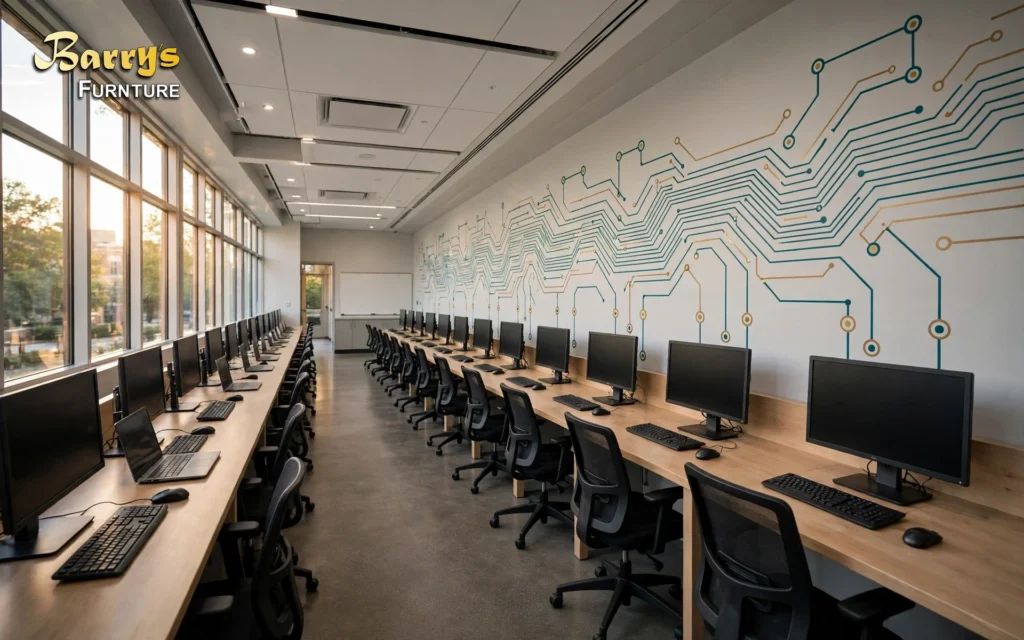
Circuit traces suit the long, low wall space above a run of desks, where posters hang too high to read. Thin lines branch and turn at right angles, ending in small node circles at each station.
Painted traces cost little; routed lines in a laminate panel cost more and look built-in. Either way the graphic follows the furniture line, so the room reads as one designed system.
- Best For: College and training labs
- Build: Paint or routed laminate panel
- Effort: Medium
- Cost Band: Rs 12,000 – 45,000
5. Technology Word Wall
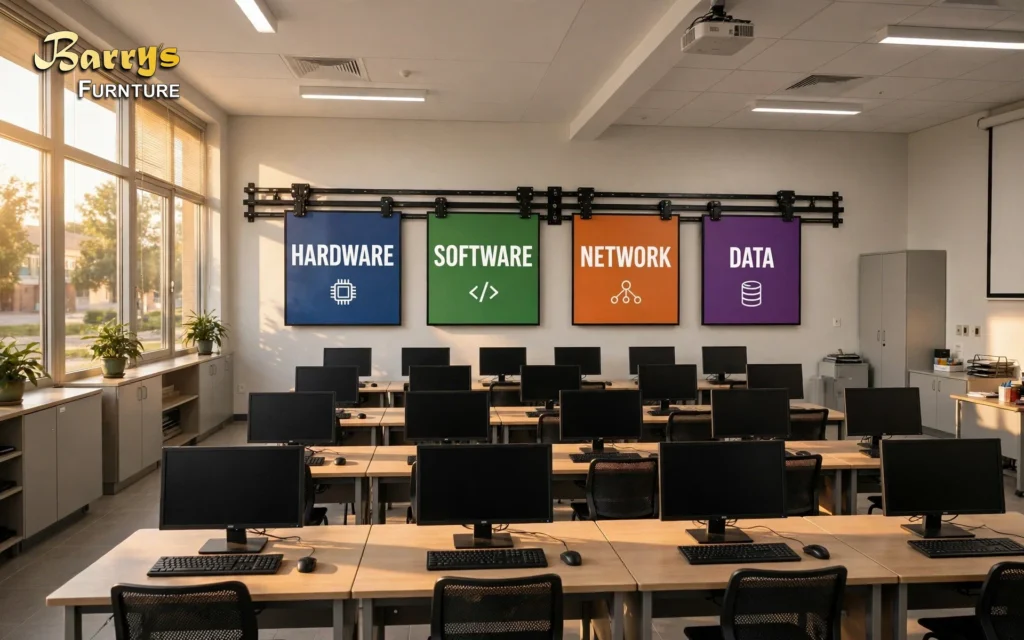
A word wall works when the words are big enough to read from the back row. Twenty core terms — hardware, software, network, data — each on its own board with a one-line meaning.
Mount the boards on a rail so teachers can slide terms in and out as topics change. The rail is the craftsman’s part: it turns loose posters into a permanent teaching fixture.
- Best For: Primary and middle school labs
- Build: Boards on a sliding wall rail
- Effort: Easy
- Cost Band: Rs 10,000 – 22,000
6. Computer Parts Labelled Wall

One wall diagramming a computer’s parts, at real scale where possible, settles a hundred small questions. Students check the wall before they raise a hand.
Build it as a shallow display panel with labelled sections for input, processing, storage and output. A clear cover keeps small hands off the lettering while keeping everything readable.
- Best For: Elementary and middle school labs
- Build: Labelled display panel with cover
- Effort: Medium
- Cost Band: Rs 20,000 – 38,000
Computer labs, classrooms, libraries and rostrums — measured, built and installed by one workshop, so the decoration and the furniture match.
See Institutional FurnitureBulletin Board and Display Ideas
7. Lab Rules Framed Board
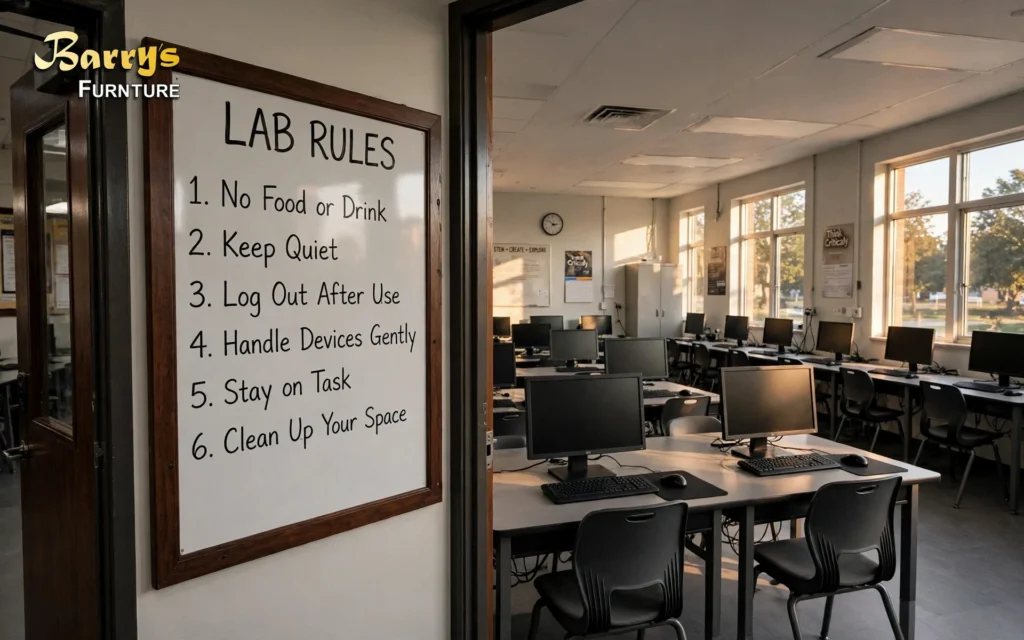
Rules posted as one framed board beside the door get read; rules taped as loose sheets get ignored. Keep the list short — six rules, large type, plain language.
A solid frame and a wipe-clean surface matter because this board is touched, pointed at and cleaned more than any other in the room. It is the cheapest behaviour tool in the lab.
- Best For: Every school and college lab
- Build: Framed board with wipe-clean face
- Effort: Easy
- Cost Band: Rs 4,000 – 9,000
8. Student Work Showcase Board

A showcase board with a proper frame and pinning surface tells students their work belongs on the wall. Rotate the display weekly and the board stays a live part of the room.
Size it for the work your students produce: printouts, drawings of hardware, project covers. A deep frame with a fabric pinning panel takes pins cleanly for years without crumbling.
- Best For: School labs of every level
- Build: Deep-framed fabric pin board
- Effort: Easy
- Cost Band: Rs 9,000 – 20,000
9. Coding Steps Process Board
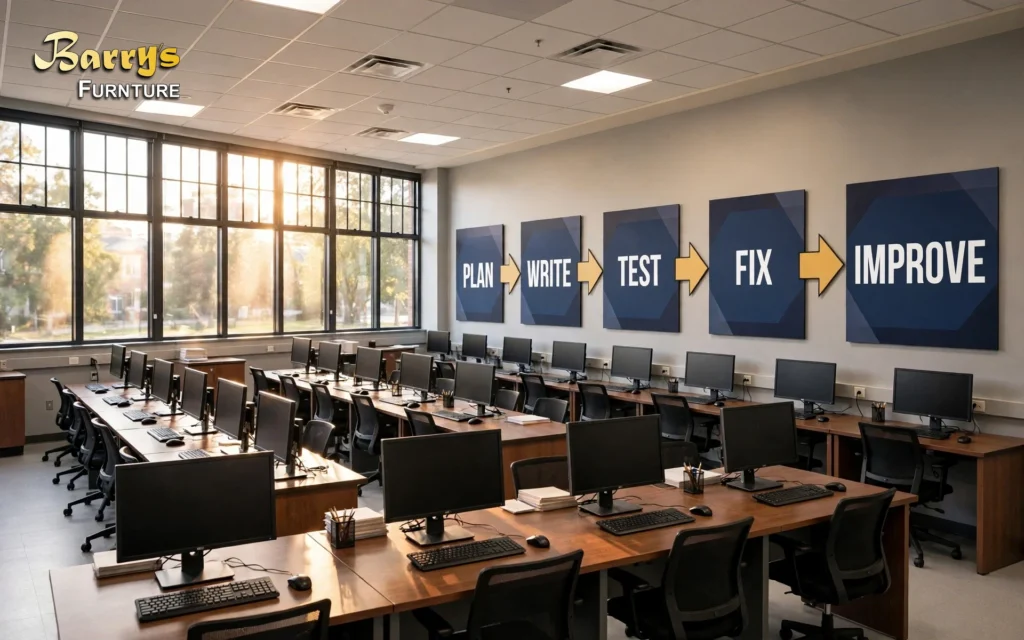
A process board breaks coding into visible steps: plan, write, test, fix, improve. Students stuck on a problem can point at the step they are on.
Five linked panels with arrows carry the sequence across a side wall. In college labs the same format holds a development cycle or a network diagram instead.
- Best For: High school and college labs
- Build: Five linked printed panels
- Effort: Easy
- Cost Band: Rs 7,000 – 15,000
10. Internet Safety Pledge Wall

A pledge wall works when students sign it. Leave a signing strip along the bottom and renew it each term, and the wall becomes a record the class owns.
Frame the pledge text at reading height for the youngest user of the room. In schools, pair it with three short safety rules in pictures as well as words.
- Best For: Primary and middle school labs
- Build: Framed board with signing strip
- Effort: Easy
- Cost Band: Rs 5,000 – 11,000
11. Tech History Timeline Wall

A timeline wall runs the length of the lab: early computers, personal computers, the internet, mobile devices, artificial intelligence. Each stop gets a picture, a name and two lines of fact.
Build it as a continuous rail with swappable cards, so new developments slot in at the end. The room gains a reference that grows instead of dating.
- Best For: High school and college labs
- Build: Timeline rail with swappable cards
- Effort: Medium
- Cost Band: Rs 14,000 – 30,000
12. Rotating Theme Bulletin Board

One board, changed with each topic, keeps a lab feeling current without redecorating the room. Themes rotate: robotics, data, design, careers in technology.
The build is a generously sized pin board with a plain frame that suits any theme. Spend on size and surface quality; the content costs almost nothing to change.
- Best For: School and college labs
- Build: Large fabric pin board
- Effort: Easy
- Cost Band: Rs 8,000 – 18,000
Furniture-Led Decoration Ideas
13. Colour-Coded Station Zones

Divide the lab into colour zones — by row, by class level or by activity — and carry the colour through desk edge bands, wall strips and station numbers. Students learn their zone on day one.
Zoning is decor that organises: a teacher can direct a class by colour, and a visitor reads the room’s system at a glance. The furniture carries the colour, so nothing peels or fades.
- Best For: Large school and college labs
- Build: Coloured desk bands and wall strips
- Effort: Medium
- Cost Band: Rs 20,000 – 50,000
14. Numbered Workstation Plaques
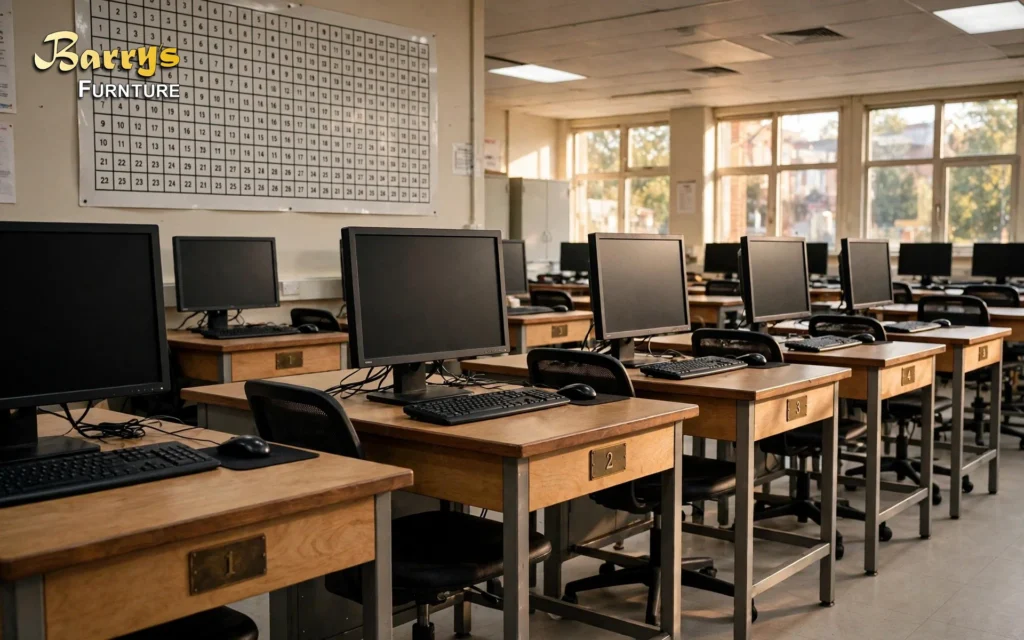
A numbered plaque on every station ends the daily confusion of which machine a student reported. Match each number to a wall chart and fault reporting becomes simple.
Engraved or printed plaques fixed to the desk edge survive cleaning and knocks. Keep the numbering logical — row letter plus station number — and paint the same numbers on the wall chart.
- Best For: Every lab with fixed stations
- Build: Engraved desk-edge plaques
- Effort: Easy
- Cost Band: Rs 300 – 600 per station
15. Built-In Display Shelving Wall
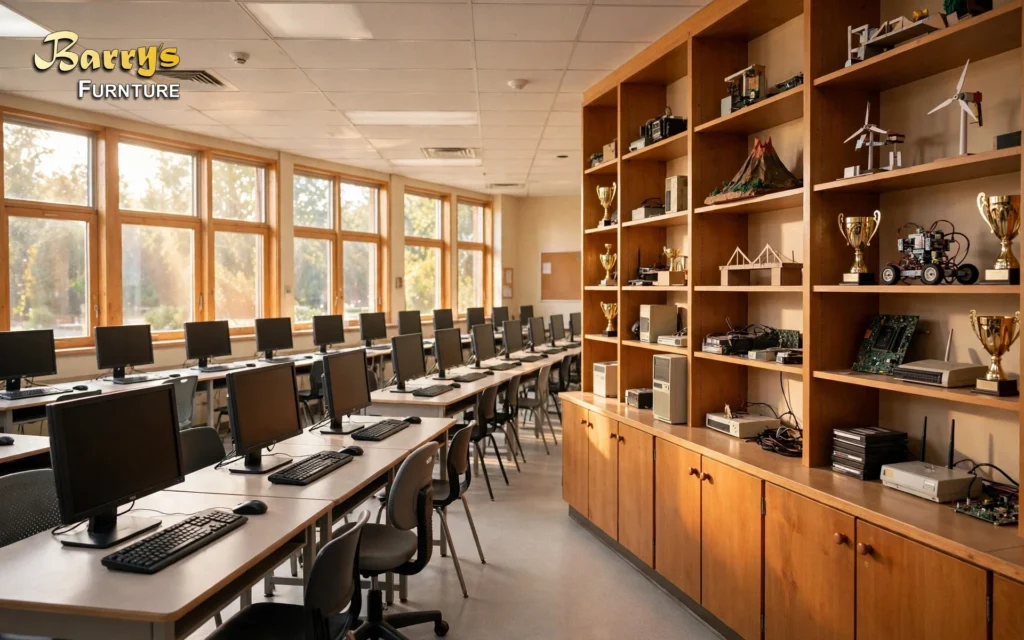
A shelving wall displays what a lab is proud of: student-built models, retired hardware, trophies, reference books. Closed cupboards below hide the clutter every lab collects.
Built-in shelving uses the dead wall between windows or behind the teacher station. It is furniture and decoration in one build, which is why institutions get the most from it. Our cabinets and racks show the closed storage styles we build below such displays.
- Best For: School and college labs
- Build: Fixed shelving with cupboards below
- Effort: Hard
- Cost Band: Rs 45,000 – 95,000
16. Acoustic Panel Colour Blocks

Computer labs are loud: fans, chairs, thirty keyboards. Fabric-wrapped acoustic panels in bold colour blocks calm the echo and decorate the upper walls in one move.
Panels sit high, out of reach, in a grid or a stepped pattern. Choose two colours from the lab’s palette and the treatment reads as design, not as sound equipment.
- Best For: College and training labs
- Build: Fabric-wrapped acoustic panels
- Effort: Hard
- Cost Band: Rs 35,000 – 80,000
17. Teacher Station Backdrop Panel

The wall behind the teacher’s desk is in every student’s eyeline for every lesson, so treat it as the lab’s feature wall. A panelled backdrop with the lab name and one strong graphic anchors the room.
Laminate or painted panels with routed lettering take projector light well and clean easily. Keep the design calm — this wall competes with the lesson screen, not with the students.
- Best For: School and college labs
- Build: Panelled backdrop with routed lettering
- Effort: Medium
- Cost Band: Rs 25,000 – 55,000
18. Coloured Cable-Channel Runs
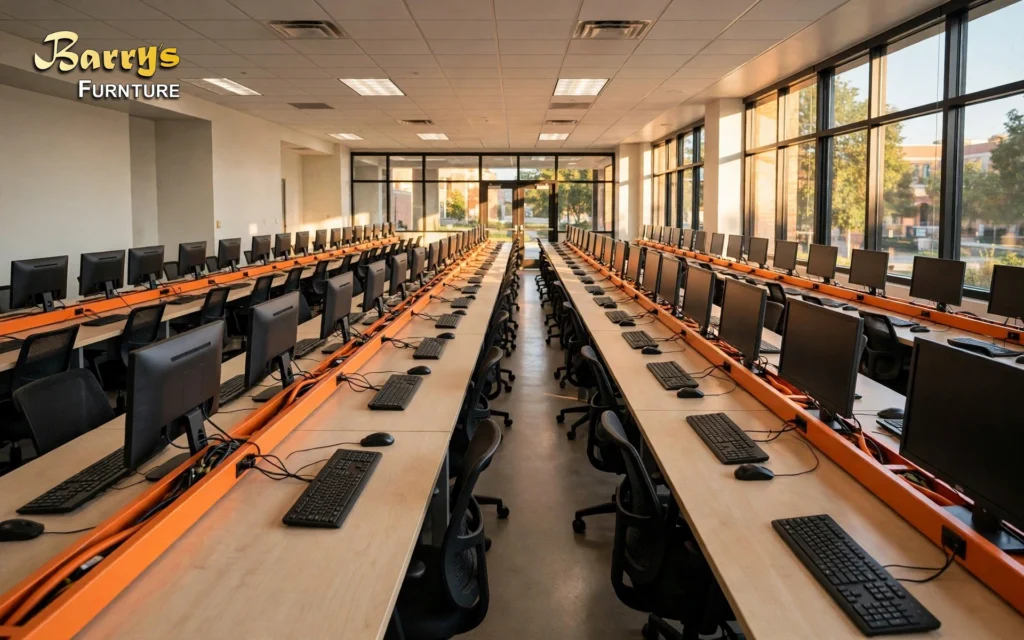
Every lab has cable trunking; almost none use it as design. Run the channels in the lab’s accent colour along the desk line and the room gains a deliberate stripe at working height.
This is a craftsman’s detail: straight runs, clean corners, colour matched to the zones. It costs little more than standard trunking and makes the installation look planned. Our workstations are built with these channel runs integrated.
- Best For: College and training labs
- Build: Coloured cable trunking runs
- Effort: Easy
- Cost Band: Rs 6,000 – 14,000
19. Breakout Reading Corner
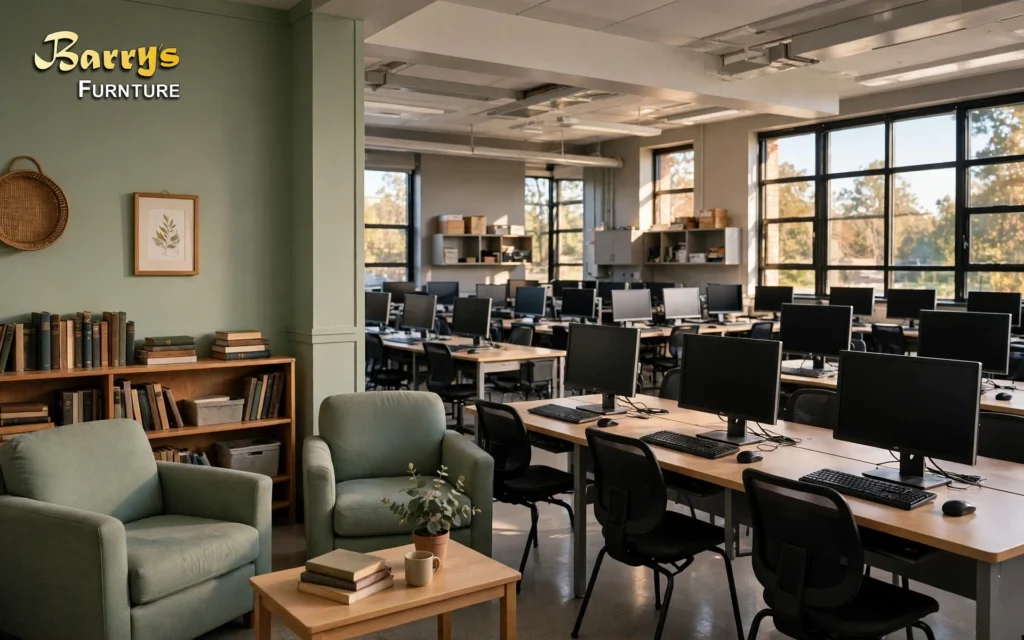
A small corner with soft seating, a low shelf and a calm wall colour gives a lab a second mode: reading, planning and quiet pair work away from screens.
Two or three seats are enough. The corner works hardest in school labs, where younger students need a reset space, and seating must survive daily use — the same durability test we build our gaming chairs for kids to pass.
- Best For: Primary and middle school labs
- Build: Soft seating with low shelving
- Effort: Medium
- Cost Band: Rs 30,000 – 65,000
Doors, Ceilings and Finishing Touches
20. Lab Door Welcome Graphic
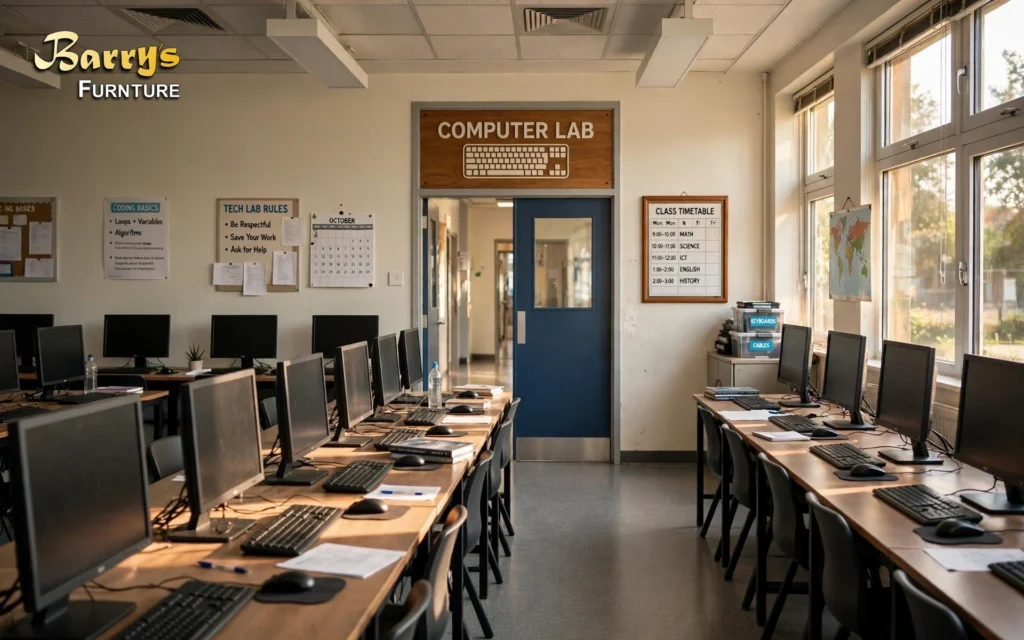
The door is the first surface every student sees, and a door graphic sets the tone before the lesson starts. Lab name, a keyboard motif or a welcome line at eye height does the job.
Use a panel or applied lettering that survives a door’s daily knocks and cleaning. Paint alone wears at the handle line within months; a fitted panel does not.
- Best For: Every school and college lab
- Build: Fitted door panel or lettering
- Effort: Easy
- Cost Band: Rs 5,000 – 12,000
21. Glass Partition Tech Decals

Glass partitions and door windows take frosted bands well: a circuit pattern or a row of icons gives privacy at seated eye level while light still passes.
Keep the band at the height where screens need shielding and leave the rest clear. Decals are the one item on this list a caretaker can replace in an afternoon.
- Best For: College and office-style labs
- Build: Frosted vinyl bands with motifs
- Effort: Easy
- Cost Band: Rs 4,000 – 10,000
22. Ceiling Tile Tech Art
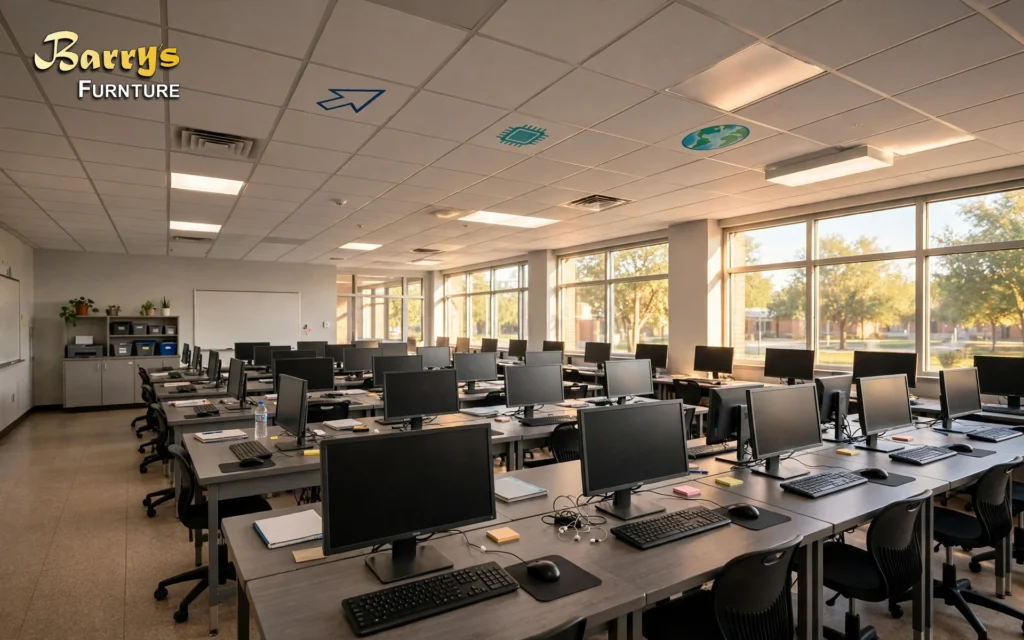
The ceiling is the one surface students stare at while thinking. A few tiles painted with icons — a cursor, a chip, a globe — reward the upward glance without distracting from work.
Paint spare tiles on the ground and swap them in; never paint tiles in place. Keep it to a scattered few near the centre of the room, not a full ceiling of art.
- Best For: Primary and middle school labs
- Build: Painted spare ceiling tiles
- Effort: Easy
- Cost Band: Rs 3,000 – 8,000
23. Motivational Quote Wall Lettering

One well-chosen quote in large routed or applied letters beats ten small posters. Place it on the wall students face when they look up from screens.
Choose words about effort and curiosity rather than success, and set them in a typeface a young student can read from the back row. Letters with depth cast a shadow line that flat print never gives.
- Best For: School and college labs
- Build: Routed or applied wall letters
- Effort: Medium
- Cost Band: Rs 9,000 – 20,000
24. Student Project Photo Wall
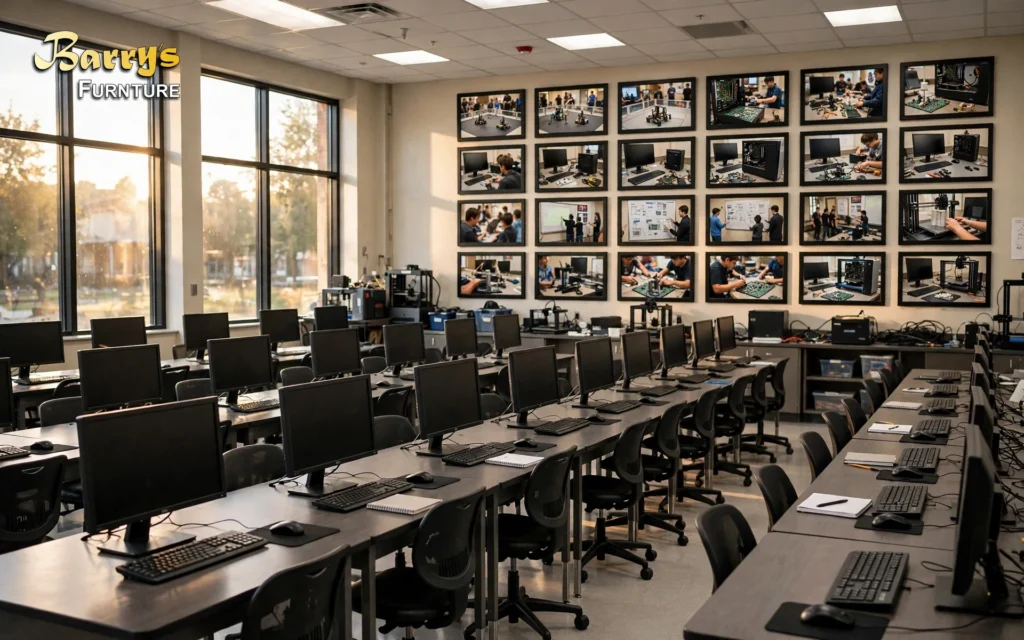
A photo wall of the lab in action — competitions, builds, class projects — shows new students what happens in this room. It is the most personal decoration a lab can have.
Use one frame size throughout and a strict grid; the orderliness is what makes mixed photos look designed. Leave two frames empty for this term’s work.
- Best For: School labs of every level
- Build: Uniform frames in a fixed grid
- Effort: Easy
- Cost Band: Rs 7,000 – 16,000
25. Award and Certificate Display Rail

Certificates taped to a wall look temporary; certificates on a display rail look earned. A rail near the door shows visiting parents and inspectors the lab’s record at a glance.
Rails hold framed certificates in a row that can grow one frame at a time. It is a small build with an outsized effect on how the room is judged.
- Best For: School and college labs
- Build: Wall rail with framed certificates
- Effort: Easy
- Cost Band: Rs 6,000 – 14,000
26. Green Corner with Built-In Planters
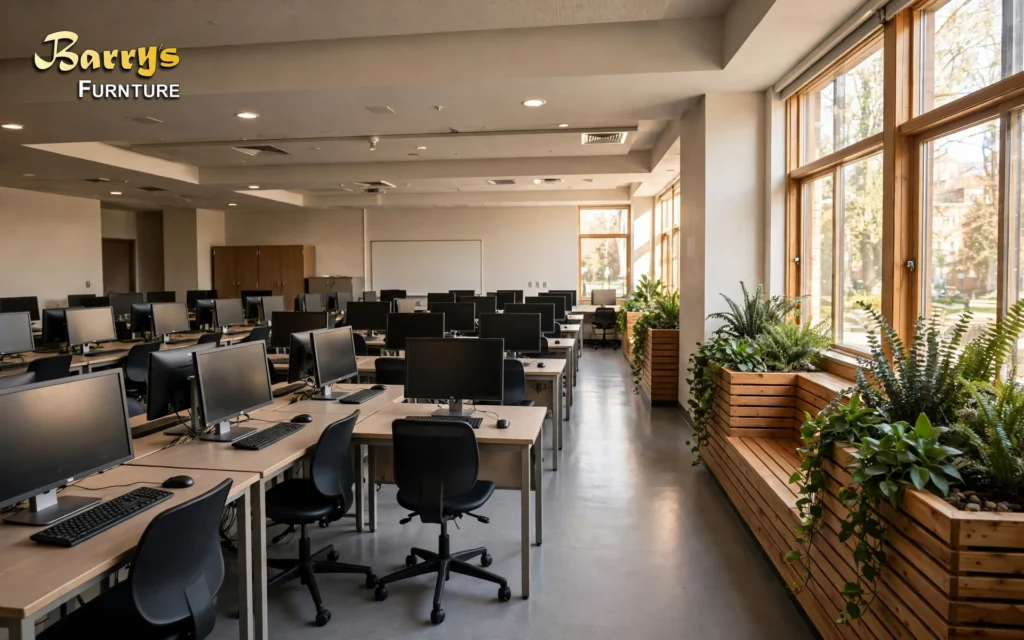
One green corner softens a room full of machines. Built-in planters at window height hold hardy plants that forgive a school holiday’s missed watering.
Fix the planters as part of the furniture run so they are never knocked over, and keep soil well away from machines and cables. The green reads against any palette.
- Best For: College and training labs
- Build: Built-in planters with hardy plants
- Effort: Medium
- Cost Band: Rs 12,000 – 28,000
27. Framed Display Screen Surround
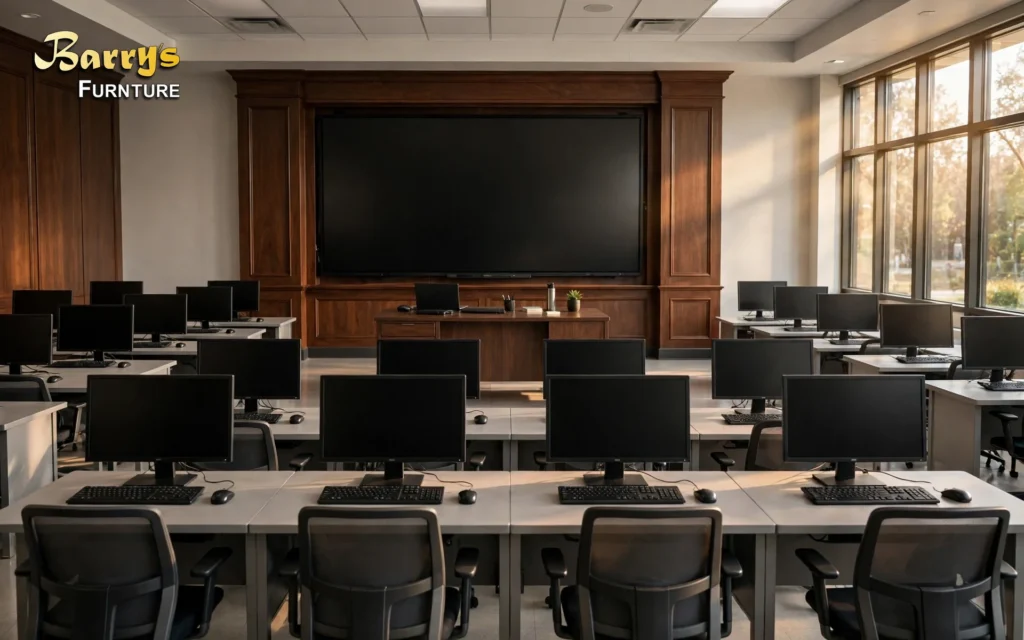
The large teaching screen usually hangs on a bare wall with cables showing. A framed surround panel hides the cables, centres the screen and gives the front wall a finished, deliberate look.
Build the surround deep enough for cable access from the side, and match its finish to the teacher station backdrop. The front of the room then reads as one composition.
- Best For: School and college labs
- Build: Panelled surround with cable access
- Effort: Medium
- Cost Band: Rs 18,000 – 40,000
School Labs vs College Labs: What Changes
The same room serves very different readers at age eight and age twenty. School labs lean on big type, pictures and colour; college labs lean on systems, zones and a professional finish closer to a workplace.
Furniture follows the same split — smaller stations and softer corners for schools, full-size runs for colleges. Our classroom furniture and study tables ranges cover both ends of that range.
| Decision | School Labs | College Labs |
|---|---|---|
| Wall content | Word walls, parts diagrams, big keyboard displays | Process boards, timelines, circuit graphics |
| Colour palette | Bright primaries in bold blocks | Two-tone palettes, charcoal and one accent |
| Board use | Showcase and pledge walls, rotated weekly | Notice, project and award displays |
| Furniture finish | Rounded edges, washable surfaces, low heights | Full-size stations, integrated cable channels |
| Budget focus | A few strong walls done well | Zones, acoustics and built-in storage |
Many labs double as exam halls and event rooms. Folding tables clear the floor fast when the room has to change jobs.
See 4ft Folding TablesGold bars show teaching impact against installation effort, from our institutional projects. Framed boards win on both counts — start there.
Decor Packages for Every Budget
Institutions rarely buy decoration piece by piece; they approve a package. These three bands cover most labs we fit out, and every package mixes ideas from the list above.
Prices are per lab and depend on room size, wall condition and how much is built-in versus framed. A site visit settles the exact figure before any work starts.
Plan Your Lab Decor
Three small planners turn this list into a decision. Estimate the budget, check what fits your longest wall, and match a colour palette to your institution.
Each planner uses the same bands and builds as the ideas above, so the numbers you see here are the numbers a site visit will refine — not replace.
Tell it your station count and decor level; it returns the package band we would quote against.
Measure your longest free wall and pick its finish; the planner counts how many display ideas it can honestly hold.
Pick your institution and the mood you want; get a palette and the three ideas that carry it best.
Advantages and Disadvantages
Advantages
- Walls teach between lessons, not only during them
- Built boards and panels last for years, not terms
- Colour zones make a large lab simple to run
- Displays give inspectors and parents visible proof of standards
Disadvantages
- Built work costs more upfront than paper prints
- Panel and shelving packages need installation time
- Too many ideas at once crowd a small lab
- Colours chosen without a palette clash fast
How to Order a Lab Decor Build
Decorate the wall students face, not the wall behind them. One strong teaching wall and one display wall beat five busy ones — and leave the remaining walls calm, because screens already fill the room with light and movement.
Lab Decor Planning Checklist
- Measure every free wall and note windows, doors and the screen position
- Choose one palette of two main colours plus one accent before buying anything
- List the charts your syllabus actually needs — shortcuts, parts, safety rules
- Decide which ideas are framed, which are panelled and which are painted
- Number every station and match the numbers to a wall chart
- Plan one display that rotates, so the room can change without new spending
- Book installation outside teaching hours and confirm wall condition first
Frequently Asked Questions
What are the easiest computer lab decoration ideas for a school?
Start with a framed lab rules board, a keyboard shortcut chart wall and numbered workstation plaques. All three fix in a day, cost little, and students use them from the first lesson.
Which computer lab wall decoration ideas suit a high school?
High schools suit a binary code accent wall, a tech history timeline and a coding steps process board. The content matches the syllabus, and the builds survive older students better than paper displays.
How do college computer lab decoration ideas differ from school labs?
College labs drop the playful graphics and use acoustic panel colour blocks, circuit-trace graphics and colour-coded zones. The aim is a professional room that still has identity, closer to a workplace than a classroom.
What should a computer lab decoration chart include?
A good chart teaches at a glance: keyboard shortcuts, file-saving steps or the parts of a computer. Keep one topic per chart, use large type, and frame charts in groups so they read as one display.
Can I get these computer lab decoration ideas as a PDF checklist?
Yes — the planning checklist in this guide prints cleanly from the browser, so you can save the page as a PDF and carry it into your lab. Tick items off as your budget approves each one.
Where does a keyboard-themed display work best in a lab?
A giant keyboard display works best on the main teaching wall of a primary or middle school lab, where typing is taught daily. In older students’ labs, the same wall space serves better as a shortcut chart grid.
What are simple computer lab decoration ideas for school on a small budget?
Painted ceiling tiles, a door welcome graphic and a student project photo wall are the cheapest strong changes. Together they cost less than one framed board set and cover door, walls and ceiling.
Which computer lab door decoration ideas make the best first impression?
A fitted door panel with the lab name and one clear motif beats layered paper cut-outs, because it survives knocks and cleaning. Add the room’s timetable frame beside the door for a finished entrance.
How long does a built-in lab decor project take to complete?
Print-and-frame work fits within a few days. Board and panel packages usually take one to two weeks including installation, and a full build with shelving and acoustic panels takes two to three weeks.
Can good decoration really change how students treat a lab?
In our installation experience, yes. A room that looks planned and cared for is treated with more care — fewer marks on desks, less damage to boards, and equipment reported faulty sooner.
Computer Lab Decoration Ideas on Video


Send us your room size and wall photos — we return a zone plan and a fixed package price.
📞 Call Now: 0309 1110444 ✉ Request Free Consultation 🏠 Visit Our Showroom10-A Wahdat Road, Muslim Town, Lahore · [email protected]